The rule is only the starting point
The law tells you what must be proved. It does not assemble your contracts, bank evidence, company history, public documents and social-security position into one case.

Spanevo focuses on Spain's Digital Nomad Visa, with particular expertise in Gulf-based professionals and their cross-border work and document chains. We also serve eligible applicants worldwide, applying the same case-specific method wherever you are based.
We help remote professionals assess eligibility, plan their route, prepare evidence, and navigate the Spain Digital Nomad Visa application process. Our work stays within immigration support. When a question requires regulated legal, tax or other professional advice, we keep it outside our scope rather than guess.
Spanevo was built around one route: Spain's Digital Nomad Visa. That focus lets us go deeper into the evidence, document chains and cross-border issues that often shape Gulf-to-Spain applications, while supporting eligible remote professionals from anywhere in the world.
The law tells you what must be proved. It does not assemble your contracts, bank evidence, company history, public documents and social-security position into one case.
Public documents may need an Apostille or diplomatic legalisation, then Spanish translation. The correct route depends on the issuing country and document.
Once the filing route, evidence dependencies and time-sensitive documents are mapped, the work stops being a pile of paperwork and becomes an ordered process.
Current law and official procedure pages are the baseline for legal thresholds and process rules.
A general requirement becomes useful only after it is tested against your work structure, dates, documents and filing route.
We distinguish statutory rules, official guidance, case-specific interpretation and commercial policy instead of presenting them as the same thing.
The Roadmap and case notes show why a document or step is required, not only what to upload.
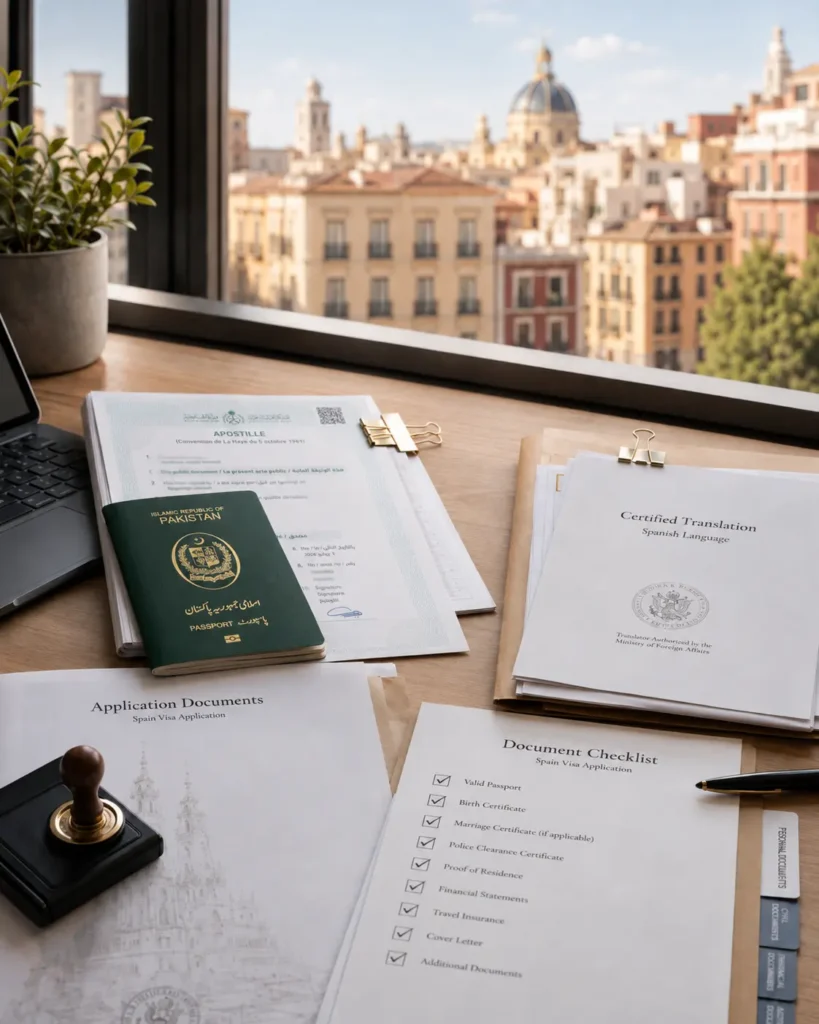
Spain applies one legal framework, but a public document issued abroad may reach the application through an Apostille or through diplomatic legalisation. The issuing country and document type decide the route.
We check whether the Hague Apostille Convention applies or whether the document needs a diplomatic legalisation chain.
Contracts, company records, invoices or payslips, bank evidence and remote-work terms should support the same relationship, dates and income position.
Foreign documents must be translated into Spanish, and public foreign documents must also meet the applicable legalisation requirement.